
As I’ve been writing this menswear blog for over eight years, it’s only natural that I start to think about what comes next.
I feel like I’ve already covered much of what I consider to be tentpoles of my personal style and taste. Sure, I still buy new clothes (largely to upgrade what I have or to replace what I don’t fit into), but these aren’t things that require additional ink to be spilled. Such items neatly fit into blog posts I’ve already written. Instead, my focus has shifted to promoting what might be considered. an “Expressive Life”, all through the medium of menswear.
That thesis is obviously sounds silly, but it truly has become a newfound cause of mine, though you might argue that it has been present all along). With each blog post, I find even further camaraderie between menswear and my passions in photography and music. In a world where clothing is a commodity and a status signifier that is meant to be replaced in order to prevent yourself from becoming “irrelevant” (a fate that some people view as worse than death), it’s important for us to make a case for expression free from capitalist (and often social) pragmatism. And the more I read, the more aware I am that others have been fighting this fight ahead of me. [No doy, Ethan– come on!]
My most recent read, Bill Ivey’s Arts, inc.: How Greed and Neglect Have Destroyed Our Cultural Rights, is one great example of that.
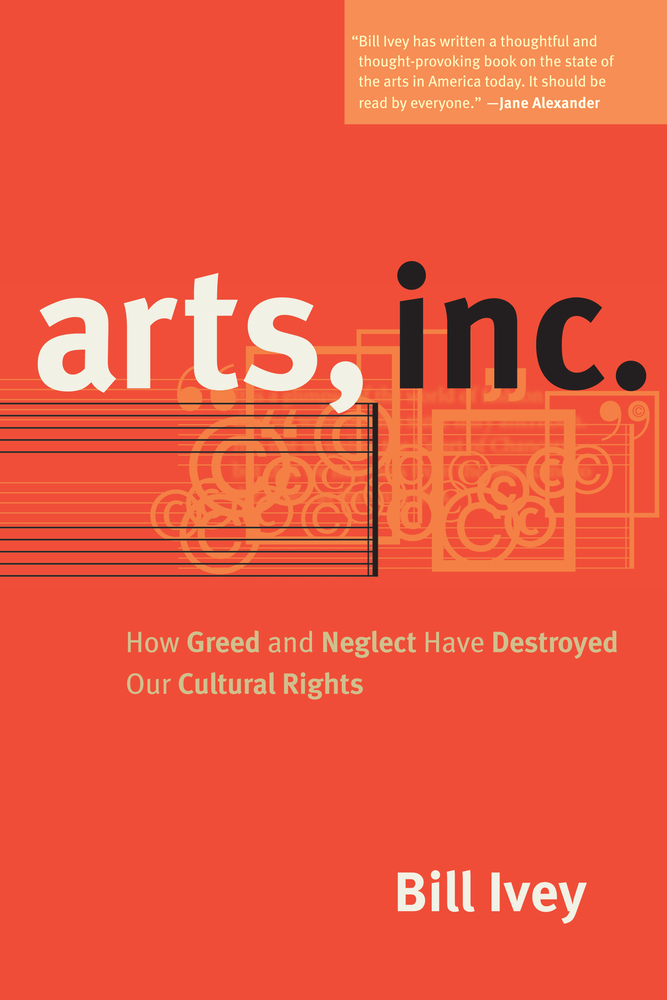
- The right to our heritage—the right to explore music, literature, drama, painting, and dance that define both our nation’s collective experience and our individual and community traditions.
- The right to the prominent presence of artists in public life—through their art and the incorporation of their voices and artistic visions into democratic debate.
- The right to an artistic life—the right to the knowledge and skills needed to play a musical instrument, draw, dance, compose, design, or otherwise live a life of active creativity.
- The right to be represented to the rest of the world by art that fairly and honestly communicates America’s democratic values and ideals.
- The right to know about and explore art of the highest quality and to the lasting truths embedded in those forms of expression that have survived, in manylands, through the ages.
- 6. The right to healthy arts enterprises that can take risks and invest in innovation while serving communities and the public interest
The list above is how Ivey starts his book; it’s literally right after the table of contents. It is his Cultural Bill of Rights, which sets the stage for the rest of his book that is all about promoting and defending an Expressive Life that he believes is in trouble of being achieved in the “modern day”. I use quotation marks because this book was published in 2008 and this definitely reads as a post 9/11, pre-Obama, pre-Facebook, pre- Instagram, pre-Tiktok and pre-streaming (Spotify, Netflix, etc.) work. Don’t let that distract you; every single one of his greater insights about culture still holds true today. And a bit of it could even be used to talk about classic menswear or fashion as an Expressive medium as a whole.
Each chapter of Ivey’s book dives deep into each facet of his Bill of Rights, going into its importance and how it is currently being undermined by the powers that be. And as you could expect, most of the negative factors stem from corporations, the wrong profiteers, and government inadequacies (or partisan infighting). For example, Ivey’s first Right is about heritage, which involves access to our rich history of culture: librettos, films, TV tapes, pressings, and so on. Art can only be created (and progress) when we can reference and utilize the past.
You might think that this is an easy feat thanks to the internet and digital archives, but the truth is that the process to do so is expensive and since much of these are in the hands of corporations, we unfortunately do not have much say on what is preserved to be used in the future. As you probably guessed, there is not much profit to be had in producing a stock of archives that only a niche few might use. And even when the history is available, it is not truly available. Much of our cultural content, from historical photographs to music, are tied up in copyright and ownership bureaucracy, with exorbitant fees (which default to the highest price possible) locking people out from using culture.
Corporations definitely take up most of the bulk in the book. Mergers and big box stores lead to the lowest common denominator in terms of culture, or at least the ones that are guaranteed to sell. To such companies, there is no point to carry things that are niche or specialized, which leads to less consumption of “non-general” things whether it’s rap or classical music. It is quite alarming to see how this focus on low-risk generated profit factors into culture, which makes these companies have much more power on the arts as they’d care to admit.
Government deserves a large amount of responsibility for the diminishment of our cultural rights. No, this is not just about funding for endowment programs (which is indeed small and spread out among too many agencies) but is rather about the laws that uphold corporations’ rights. Excessive copyright holding is there because of laws. The FCC plays a strong hand in what is able to be said across nearly all aspects of culture. Ivey even has a section on Net Neutrality, which is still being discussed today.
Again, all of this seems pretty banal to those familiar with the state of the arts in the United States. But the reason I am sharing this book with you is because of what is sprinkled between his criticisms: Ivey’s passionate plea for everyone to achieve an Expressive Life.


From my reading, an Expressive Life is one free from the ires of capitalism and traditional productivity, where its focus is on the agency to create something that challenges us, brings about authenticity, and can be a mark of personal achievement. In other words, an Expressive Life is a “way to pursue success and self-realization without forcing us to buy into the nastiness of America’s unhappy rat race”.
Ivey’s belief that we have a Right to such a Life is what informs the entire book. Corporations and government failings are all hindrances to this ideal, an ideal mind you, that requires only a little push to me made available for all. Ivey posits that art-making ties us intrinsically to artists of the past (heritage), which is why he focuses on the harsh copyright laws that make it impossible to learn about and transform the past. He also laments that participation in the arts has been relegated to art appreciation classes and simply consumption instead of doing. After all, when we participate in sports or exercise, we do it. It is here that he asserts that art making doesn’t need to be “serious”; it can be akin to pick-up football games in the park.
Now I bring this up because I truly think that an interest in clothing is a small, easy step to having an Expressive Life. There is a lot within the hobby of getting dressed that forces you to utilize concepts of authenticity, expression, and POV, all of which are elements of art making. If done with proper introspection and interest, getting dressed is an exercise that allows you to reach a simplified form of self-realization and can make you happy with your perceived success in doing so. That’s definitely happened for me and my friends!
Yes, clothing serves a practical function but once the basics of covering a naked body has been accomplished, there is still more to be done with it; that’s what makes it such an interesting aspect of an Expressive Life. And don’t worry– if expression is not a priority, you’re more than welcome to wear a tee shirt and jeans to 90% of what encompasses a typical American life.
To be clear, I am not saying that “putting on clothes” should be considered a fine or high art. That would be absurd! I am saying that the activity of putting on clothes is an aspect of an Expressive Life. It is a gateway drug to discovering other ways in which we can be Expressive.
In my case, it has been very clear that my passions in photography and music assisted my approach to menswear, but it is also clear that the philosophies I’ve developed during my clothing habit have gone the other way. With how Cinematic Dressing involves constant introspection, awareness of expression, and a priority on POV is, I’ve been able to engage with art at a level I never have before. Over the years, my participation (and consumption) of art has been much more intentional, personal, and most importantly, familiar. While I am destined to remain an amateur enthusiast (I am plenty aware of my technical skills as well as my own narcissism), I know that art, or at least an Expressive Life, is something that I can do.
That’s why I believe all of this could potentially start with an budding appreciation of the Expressive properties and possibilities with classic menswear (or any form of dress honestly). I have quite a few friends and mutuals have also developed or even rediscovered Expressive passions during the course of their menswear journey. A rising tide lifts all ships!

And that brings me to the other interesting part of his book I found kinship with. In the discussion of “Art of Lasting Value”, Ivey levies a few critiques at art (or rather the art community) itself in order to explain why classical music has been “dying”. Yes, corporations may arbitrarily separate classical from pop music, which does have an effect on consumer perceptions, but that isn’t the full picture.
Ivey says that classical music has tried to be two things at the same time, which has taken itself out of the cultural mainstream (and therefore conversations about advancing art). “First, it claims to be unique, challenging, and accessible only to those willing to study and reflect …But at the same time it claims universal value; it is the music that everyone should listen to”. Ivey goes on to reference NYT critic Bernand Holland in a section that accuses music appreciation of being an attempt to “remedy the assumed illiteracy of the ‘unwashed”…[while] simultaneously disabuse them of ‘base’ attachments…Listen to the symphony long enough and you’ll give up all those hip-hop CDs”. As Ivey (and by extension, Holland) summarize, “education and knowledge do not produce love and respect”. This is the failure of classical music.
If this sounds familiar at all, it’s because I’ve already used such rhetoric numerous times on the blog in regards to why I believe classic menswear has fallen out of favor or at least isn’t seen as a viable, Expressive medium. Classic menswear remains firmly on that odd pedestal of being what everyone should wear (lingua franca?) and being the ultimate IYKYK form of clothing that would put archival fashion to shame. This aspect, combined with the fact that all menswear content (even now in the Tiktok era) is still firmly about education is the reason why classic menswear continually falls out of favor. That type of faux-proselytization (unsolicited preaching) doesn’t do anything other than keep this niche on that unfortunate pedestal. The Sword of Damocles is sure to fall.
Ivey’s solution in 2008 was to follow classical ensembles that work hard to shed the “Old World Attitude” and meet new audiences where they are, opening them up to the Expressive merits of the orchestra. In 2022, I believe that this has been done. Perhaps this is because I am more “into” art than ever before, but I am more aware of the opportunities locals have to enjoy concert work in a way that is complementary to other types of music. We’ve still got a long way to go to make art making as available as pick-up football in the park, but at the very least the attitude toward art is opening up.
Classic menswear has certainly become more open, which is clear through the mixture of traditional and new genres in the current “Post-Pandemic” Mood. Alfargo’s Marketplace is a shining example of this, as it is a fashion community that celebrates the variety of expressions available through classic menswear. This is no doubt due to the fact that organizers and attendees alike are all a part of the new guard revolutionizing men’s fashion space. It’s also great that this revolves around reselling and passing along pre-owned garments as a way to participate in trends rather than constantly buying new. It is proof that Classic Menswear can indeed connect with people in terms of community and self-realization and not just something to wear to the office.
With that being said, I am still looking toward the future. A future where classic menswear is fully considered not just because a hot Silverlake guy is wearing big pants and loafers, but because one can find Expressive camaraderie with such garments whether he gets social benefits or not. It is hard to confront our capitalist world that focuses on traditional status and benefits (and also rewards those who play within the system), but that doesn’t mean we shouldn’t try to change it.
The reality is that the freedom to wear clothes the way we want to is intrinsically linked to the right to explore music, drama, painting, and dance. It is no wonder why there is such a connection between creating an outfit and composing music or taking a photograph. These things are a big part of me just like wearing spearpoint collars and wide fit trousers. However, the idea is that fashion should inspire you to find additional avenues of Expression. Expression is a holistic thing after all.
This means we need to re-evaluate how our society gives out status and that we should celebrate the few opportunities of Breathing Room we get that are free from external pragmatism. We may even have to be pragmatic (lol) in creating Breathing Room in the first place. In other words, it is clear that we need to fight for the Right to have an Expressive Life.
Your outfit will thank you for it.
Thanks for reading! Don’t forget that you can support me (or the podcast) on Patreon to get some extra content and access to our exclusive Discord.
Always a pleasure,
Big thank you to our top tier Patrons (the SaDCast Fanatics), Philip, Shane, Henrik, and Alexander.
 a little bit of rest
I recommend reading about the Arts and Crafts movement, especially William Morris, for an earlier expression of the desire for everyone’s life (not just those of the rich and privileged) to be filled with beauty, and for labor to be fulfilling to the self, not simply mindless toil for money. Perhaps there’s an intersection with menswear in that Morris was deeply conflicted about the necessary operating costs (and resulting high prices) of what he himself made; similarly, quality clothing remains expensive and often inaccessible to many.
LikeLike
That’s a great idea! Ivey does talk about the Morris and the Arts & Crafts movement in the book just as you say (a response to industrialization, etc). However, I did not know that Morris was conflicted. That’s very interesting and definitely pertinent to menswear. I’ll definitely dive deeper! Thank you for the suggestion!
LikeLike